
Zeke Vanguardia ’27
EE Staff Writer
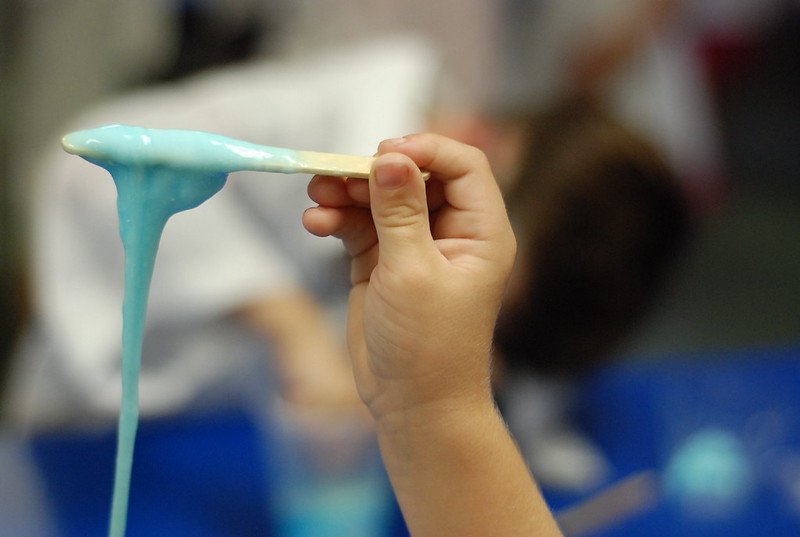
Ever wondered why those “Slime Recipe NO BORAX” videos never truly lived up to their name, often leading to a soupy solution left next to the yogurt in your fridge? The process of making slime actually comprises a multitude of molecular interactions, which give way to the substance’s distinct stretchy properties!
Slime is a non-Newtonian fluid, defined by its changes in viscosity when stress is applied. In particular, it is dilatant (shear-thickening), meaning that the substance becomes more viscous when subjected to a pressure or a force. Other examples of dilatant non-Newtonian fluids include oobleck (cornstarch + water), and quicksand.
The typical slime can be easily made using two ingredients: Elmer’s Magic Liquid (or activator) and liquid glue. Slime is a homogeneous mixture, meaning that the components are relatively evenly distributed and are in uniform throughout the substance; the solute is completely dissolved into the solvent.
Elmer’s Magical Liquid, or activator, consists of boric acid or sodium borate, as well as other chemicals which improve the solution’s stability and shelf-life. The “magic” of the solution itself derives from its composition of boric acid (H3BO3), a weak acid that releases borate ions (B(OH)4–). Other recipes may also call for the use of borax, which when dissolved in water, releases these borate ions. This solution will also act as an activator for slime.
The usual store-bought liquid glue consists of polyvinyl acetate (PVA), which are synthetic polymers. PVA is typically formed through a process called addition polymerization, where monomers are linked together without the elimination of atoms or molecules during the reaction. PVA is synthesized on a carbon backbone with a hydroxyl group (-OH) on every alternating carbon, allowing for polymers to form hydrogen bonds (water soluble). The average PVA chain can have a molecular weight of over 100,000 grams per mole!
When the activator and liquid glue are mixed together, the borate ions will begin to form hydrogen bonds with the hydroxyl groups of the PVA polymers, resulting in a cross-linking reaction where two or more molecules are joined together through the formation of molecular bonds, forming a complex chemical network. These interactions cause the PVA to twist and turn, resulting in the overall properties of slime!
Photo courstesy: Josh Hallett CC BY 2.0