
Lena Echer ’27
EE Staff Writer
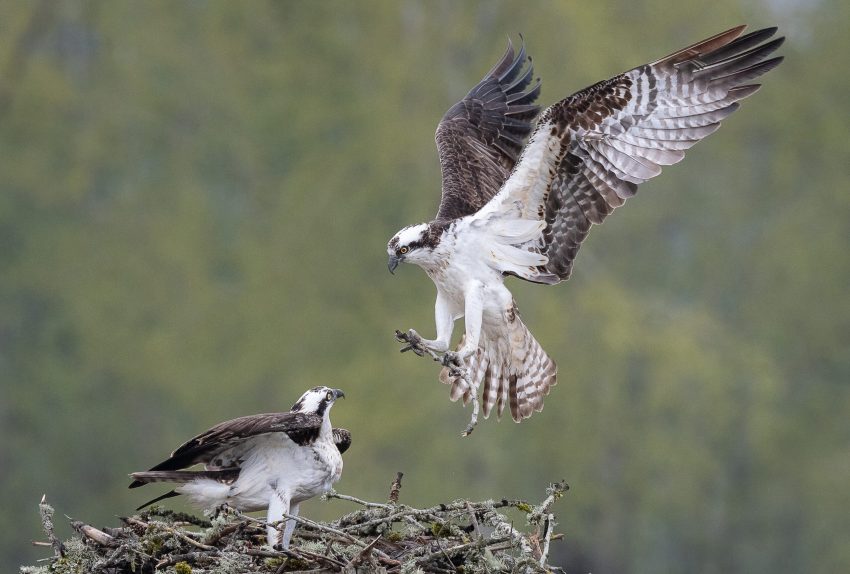
This summer, I had the great pleasure of volunteering as a citizen scientist with Osprey Nation, a specific program of the Connecticut Audubon Society, as part of my efforts to learn more about conservation and other environmental concerns. The program aims to monitor the nests of ospreys, a bird of prey common along the New England coastlines. It is part of the larger purpose of Audubon societies, from the local all the way up to the national level, which work to learn about and protect birds and the habitats they depend on.
Osprey Nation is a citizen scientist initiative founded in 2014 that relies on volunteers to monitor nests, record their observations, and report the data they gather. Volunteers record information such as the location and condition of the nest they are stewarding, the number of adults seen at that nest, the adults’ behavior, the number of chicks that hatch, and how many of those chicks make it to the fledgling, or teenage, stage (indicating the breeding success of the nest). The season runs from April through September, and volunteers typically make weekly observations to report.
But why monitor ospreys? The answer lies in the birds’ connection to Connecticut’s waters. Ospreys’ primary prey is fish, and they nest in close proximity to bodies of water, whether that is a river, lake, the Long Island Sound, or the ocean. If there is something wrong with the health of these underwater ecosystems, the health and breeding success of the ospreys that depend on them for food will reflect that problem. Additionally, ospreys almost went extinct in the mid-1900s because of the use of pesticide DDT, a common pesticide for crops. The chemical leached into waterways and then into the fish living there. Ospreys who consumed the poisoned fish often suffered from the chemical they consumed. The species experienced mass eggshell thinning and reproductive issues. As a result, fewer and fewer chicks were born each year, and even fewer survived to adulthood, and the population decreased drastically. They have since made quite the recovery and are presently considered “not globally endangered”, but they are still monitored in order to catch and prevent any further problems.
I found out about Osprey Nation in March of this year, and signed up to monitor two nests in Bridgeport. I was still figuring out what I want to do in college, and to me, this was an opportunity to get some kind of experience of work I might want to do in college and as a career. It was also a chance to get involved in something local. I’m incredibly glad I did. I started going in late April to make observations on my nests. One of them was abandoned all summer, but the other was home to a pair of adults, who were quite successful with their single chick. I watched as over the course of 6 months, they incubated, hatched, and raised their chick. Seeing the chick go from a scraggly-looking little baby to a feathered fledgling, and seeing it fly out of the nest on its own, was awe-inspiring. It felt very special to watch such a beautiful animal grow.
I went every week to make observations. I recorded my data in my Notes app, and when I got home I would use my computer to input it into the reporting form on the Osprey Nation website. The whole weekly process typically took no more than 1-1.5 hours, so it was easy to fit into my schedule no matter how much I was doing at any given week. Best of all, it was rewarding to know I was helping take care of a bird that I see so often and am so fond of.
I really enjoyed my experience volunteering for Osprey Nation, and I hope to continue doing this kind of work in college and beyond. And while Osprey Nation is a very specific program, there are many, many other initiatives that deal with different aspects of the environment. If you are interested in doing any kind of volunteer work for an environmental cause, or anything else that you care about, I highly recommend finding a program to volunteer for. They always need more help, and it is a good way to do some good in the world.
Feature Photo Courtesy: Oregon Wild