
Lola Karimi ’25
EE Editor-in-Chief
“I Gave It To Myself, It’s Given To Me By Me”
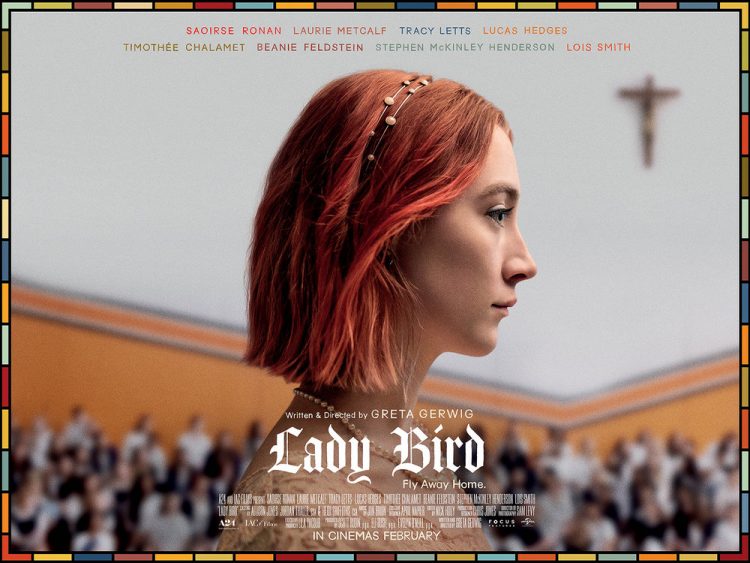
In 2017, Greta Gerwig introduced us to the character of Lady Bird, depicting a person who can love home and still desperately need to leave, and how somehow between the two there exists a perpetual space of longing.
The movie follows Christine “Lady Bird” McPherson through her senior year of high school as she plans her escape from her small town and family by going to college in New York, much to her strong-willed mothers criticism.
This film offers such a grace to the changes and imperfections that make us human. Steadfast on the idea that throughout life, you will inevitably have to ask for forgiveness and make mistakes, and it is with these moments that you will find yourself. Loosely autobiographical, the viewer gets to experience the emotional world of its characters. Her fight for her own name represents the struggle she faces for her own identity rather than the one predetermined by her overworked mother.
Lady Bird’s desire for pleasures, the sense of freedom, a freedom that only money can buy, butts heads with her extraordinarily frank mother. A nurse who puts in long hours, she never hesitates to paint a candid picture of her and her family’s struggles. It seems all relationships are tempered by money. Lady Bird wants to, above all, escape her hometown of Sacramento and attend college on the East Coast- if not in New York, then “in Connecticut or New Hampshire, where writers live in the woods”. With Marion McPherson (said mother) insisting they can barely afford sending her to state school, she goes around her back to her more laid-back father, Terry, and completes a financial aid application. When the secret is out though, it drives a massive wedge between the already tense relationship between Lady Bird and her mother.
Relationships explored include Lady Bird’s friendship with Julie (who lives in a modest apartment with her single mother), her sweet romance with Danny (whose grandmother lives in her “dream house), or the next on the roster, the rockstar Kyle (who claims to “hate money” yet lives a life of comfort on his family’s dime whilst attending a costly private school. And this is all not to forget her effort to befriend the school’s wealthy queen bee, Jenna, by posing as a rich kid herself. Instead of romanticizing these common struggles, she shows the wear and tear it has on Lady Bird.
I adore coming of age movies. For many, this genre is a reflection of their adolescence that comes with milestones such as graduating from high school, going to prom, and experiencing the dreamy eyes of young love. These films show the characters developing from their silly teenage selves and learning about the pains and responsibilities of the adult world.
For me, the thing that separates this from most coming of age films is how believable the main character is. It is just a unique, very well-written take on a very complex but also mostly universal type of relationship. All the actors are pitch-perfect as well, and it’s got both heart and humor in spades. The movie is extremely simple, dreams of something bigger but then realizing you have to ground yourself in what you have and who you are. The beauty is in the subtlety and nuance of Gerwig’s understanding of that mother daughter dynamic, so despite it being very unmistakable it is more than the sum of its parts. Real life usually does not flow in big dramatic arcs with pivotal moments of personal growth. It is more messy with detours, dead ends, mistakes, and so forth.
Lady Bird wasn’t inherently a good person. Like most teenagers and people in general, she lies, is stubborn, argues, makes bad choices and then has to deal with the consequences of these actions (her mom not speaking to her and her best friend leaving her behind). It makes her character four dimensional and more believable.